Exceptional transport
The portal to send a transit request to the Mont Blanc Tunnel
The transit of vehicles belonging to category B - exceptional convoys is subject to an authorization request.
Verify categoryTMB-GEIE (SITMB) competence section subject to prior authorization by the Traffic Security Department
Send now your authorization request
The exact time of passage through the tunnel will be determined by the PCC (radio control room) based on traffic conditions and any ongoing work in the tunnel.
- 21:00 - 22:00
- 06:00 - 07:00
Time slots in which exceptional transport transit is permitted
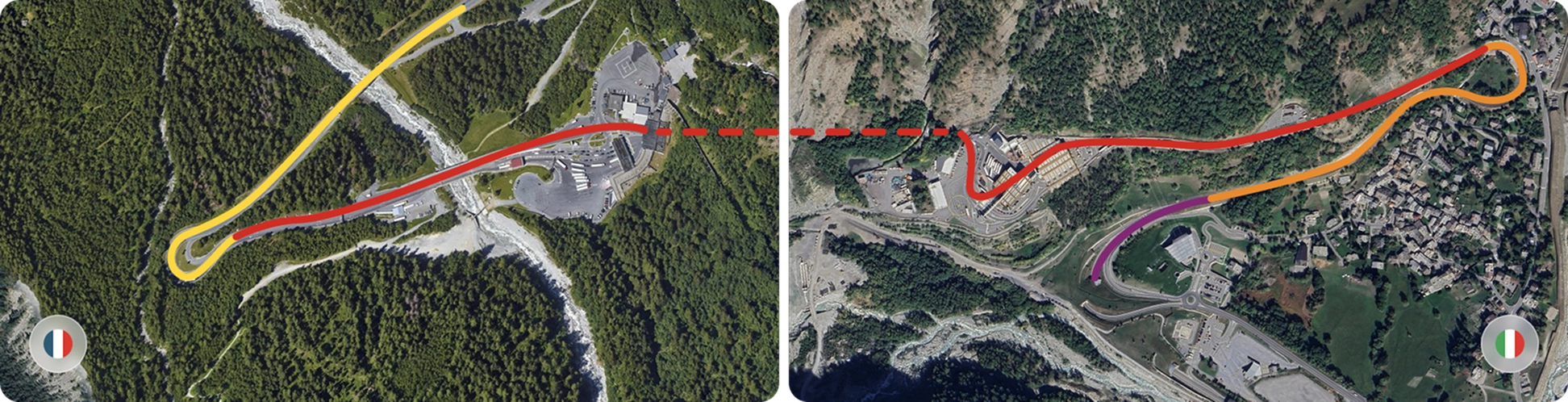
Indications for transit on access roads
Convogli che non sono accompagnati da una scorta tecnica
Obbligo di transitare alle Aree di Regolazione di Passy o di Aosta prima di raggiungere il traforo del Monte Bianco.
For all convoys exceeding 44 t, access to the Mont Blanc Tunnel ramp on the Italian side is regulated as follows
- Upon reaching Courmayeur (about 5 km from the tunnel entrance), the convoy driver must notify the PCC by phone at (+39) 335 666 32 24 to arrange passage on the access ramp to the Mont Blanc Tunnel.
- The maximum allowed speed is 5 km/h, and the convoy must travel in the center of the roadway.
Convogli che non sono accompagnati da una scorta tecnica
Obbligo di transitare alle Aree di Regolazione di Passy o di Aosta prima di raggiungere il traforo del Monte Bianco.
For all convoys exceeding 3.5 m in width and/or 94 t and/or 25 m in length
It is mandatory to contact the ATMB AUTOROUTE Control Center at least 72 hours before the expected transit date to arrange the escort. Phone number: (+33) 04 50 07 29 29.
Authorization to pass through the Mont Blanc Tunnel will only be granted after ATMB confirms the escort arrangement.
All convoys exceeding 44 tonnes
- Transit on the South ramp is escorted by TMB-GEIE.
- All convoys parked in the Italian plaza after transiting France → Italy must notify the PCC at (+39) 335 666 32 24 before departing to receive the mandatory TMB-GEIE escort on the access ramp.
Dimensions, shapes and transit rates
Dimensions beyond which vehicles are considered exceptional under the traffic regulations of the Mont Blanc Tunnel.
1 A preliminary inspection will be conducted to all convoys with a gross weight exceeding 48 tons, before obtaining the authorization on the Italian access ramp and with that the authorization to cross the tunnel.
2 Vehicles with a length under 21 meters and not exceeding the standard max sizes are allowed to cross through the tunnel even during the day.
3 Vehicles with a height between 4.05 m and 4.20 m and not exceeding the standard max sizes are allowed to cross the tunnel even during the day and should be considered as an A type convoy.
Classification of convoys under the Traffic Regulations of the Mont Blanc Tunnel
Type A convoy
Mandatory transit through the regulation area towards the tunnel – No prior authorization required.
 m 2.60 for refrigerated trucks
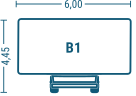

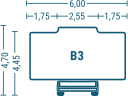
All exceptional transports are accompanied by TMB-GEIE personnel during transit in the tunnel without applying the supplement to the rate. From the second convoy of the same transport company transiting the same night, the transit rate for type A convoys will be applied. (Class D)
Useful documents
Download documents
Frequently asked questions
A temperature of about 20 degrees is fairly constant in the Mont-Blanc Tunnel in all seasons. In the winter – when the outside temperature is below zero - the interior is quite warm. Consequently, just a few metres from the entrance, the vehicle windscreen will fog up on the outside because the warm air condenses on the cold glass. Using the wipers briefly is enough to clear the windscreen. However, if the vehicle is covered with snow, Tunnel personnel will ask you to remove it because the internal temperature will cause it to drop off suddenly during the almost 12 km journey through the Tunnel, creating problems for the safety of other users.
The safety barriers are lowered after the traffic lights are switched to red. So you are obliged to stop! The electronic variable message boards overhead or close to the barriers will inform you about what to do. If the doors of the safe shelters are flashing, if the messages on the electronic boards tell you to, or if the operator asks you to on the radio, make your way to the nearest safe shelter and do not go back into the Tunnel until you are invited to do so. The video telephones inside the safe shelters allow you to contact the operators, who will give you the necessary information about what to do.
If your vehicle has a breakdown or a technical problem, try to reach a parking area: there is one every 600m on your right. Park your vehicle and call for assistance using the emergency call post in the safety booth. Be aware that the surveillance system is able to follow your situation at every moment. If your vehicle stops on the carriageway, try to get as close as possible to the edge of the pavement.
The traffic surveillance operators are able to broadcast information messages live to your FM radio. To receive the messages all you have to do is listen to the radio on one of the 12 frequencies that can be received in the Tunnel. As well as this every 6 minutes messages recorded in 3 languages (Italian, French and English) are sent out reminding you about the safety rules to be observed during transit.